
O / 05
The Language
of Shapes
ON LEARNING
HOW TO SEE
I try to keep the walls in my home quiet. Most of the room is made of warm woods, stone, clay, and natural light. The palette stays restrained so the objects can breathe. But every so often, a small piece of color appears— not to interrupt the room, but to give it rhythm.
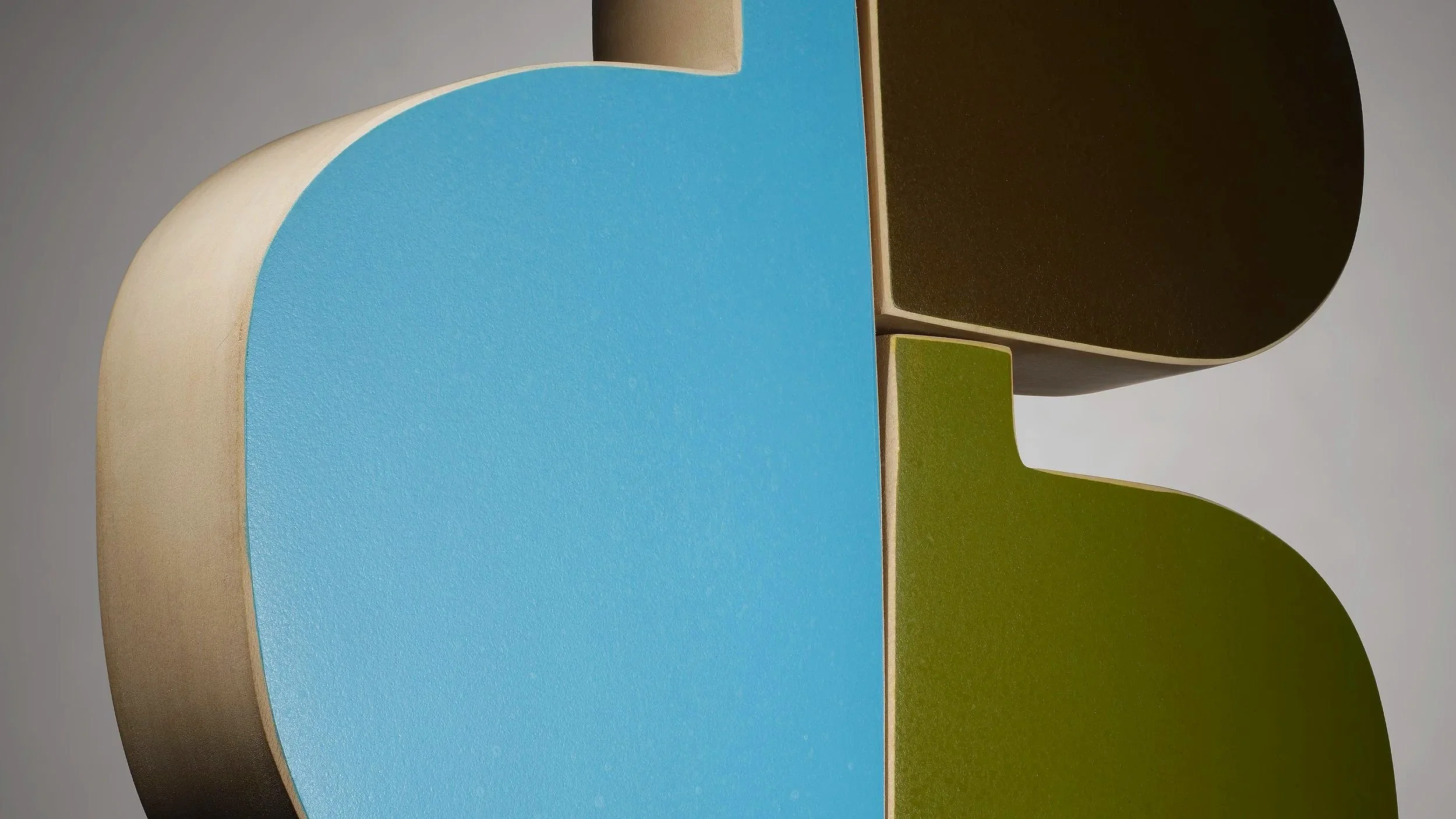
This wall sculpture by Scott Troxel is one of those pieces. When people ask why I'm drawn to work like this, I never quite know how to answer. I don't see three abstract forms mounted on a wall. I see something much older than that.
I see my first foundation class at the Fashion Institute of Technology. We spent weeks working with nothing more than circles, squares, rectangles, and triangles. We arranged them over and over again, learning that composition wasn't about decoration. It was about relationships. Balance. Tension. Movement. Space.
It felt almost like learning another language. At the time, I thought I was studying graphic design. Looking back, I realize I was learning how to see.
Those exercises became the foundation of everything that followed—every layout, every photograph, every film, every room I've ever arranged. Even today, I instinctively notice the space between forms as much as the forms themselves.
Perhaps that's why Scott Troxel's work feels so familiar. These aren't simply geometric shapes. They carry the warmth of wood, softened by hand and color. They remind me that abstraction doesn't have to feel cold. It can feel generous. Human. The sculpture doesn't dominate the room. It quietly changes how the wall is experienced.
The longer I live with pieces like this, the more I realize that art isn't always something you understand immediately. Sometimes it simply asks you to look a little longer. And if you do, you begin to notice relationships instead of objects. Negative space. Balance. Silence. Eventually you realize that those lessons extend far beyond design. They become a way of moving through the world.
Perhaps that's what my foundation class was really teaching me all those years ago.
Not how to compose a page. But how to pay attention.
OBJECT: 3 JUGS WALL SCULPTURE
ARTIST: SCOTT TROXEL
MATERIALS: BASSWOOD, ACRYLIC, POLYACRYLIC
MADE IN: NEW JERSEY, 2022
PHOTOGRAPHY: TAKAHIRO IGARASHI